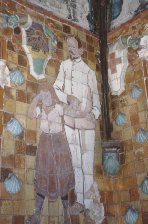
I knew about the existence of this building from the archives of De Porceleyne Fles factory in Delft I examined in 1982-84 as part of my study of architecture at Delft Technical University. I remember there were some original designs of the tile decorations in the archive, one of which I made a slide picture ... Parts of this important commission were exhibited in the Museum of Kunstnijverheid (Arts and Crafts Museum) in Haarlem in 1910. In an article on this exhibition in the architectural magazine Bouwkundig Weekblad by Jan Fratama this commission is mentioned in extent: |
![]() |
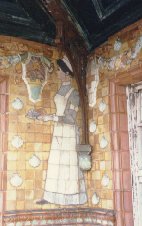
'This hospital is composed of 6 pavilions each with a frieze of 100 meters. On behalf of the architect Raymond T. Almirall this important commission had to be carried out in gay colors. This has been achieved; on a background of golden tiles the Renaissance fruit garlands and the life size very naturalistic and strong figures come out very strongly; these figures are taken direct from reality ... The whole is bold, American-like, but not at all mean.'
The technique (sectile) used for Sea View Hospital was introduced at the famous 1900 Paris World Fair. The word sectile is a fantasy-name derived from the Latin: secare (to cut), the divisions are not straight, as with conventional tiles, rather, the tile joints follow the lines of the composition. The material is a strong paste, fired at very high temperature. The technique was especially developed by the technical director of De Porceleyne Fles, a Dutchman named Heinrich Wilhelm Mauser. |
![]() |
Return To Women's Ward Pavilions
last revised April 19 1998
by David Goldfarb